The Craft Series Issue 07
How Perfume Is Made in a Small Atelier, From Formula to Bottle
How perfume is made in a small atelier: an idea becomes a formula, the formula a batch, the batch rests and is judged, and only then is it a bottle.
Perfume is made in six stages: an idea becomes a formula, the formula a batch, the batch rests and is judged, and only then is it a bottle. In a small atelier the same hands carry every stage, and the bottle exists only once someone who could have said no has said yes. The proportions stay at the bench.
How perfume is made in a small atelier: an idea becomes a formula, the formula a batch, the batch rests and is judged, and only then is it a bottle. The whole road has six stages, and the house walks every fragrance down all of them, in the same order, with a written record at each. What follows is that road, drawn from one end to the other.
The other articles in this series each take one stage and go deep: the rest, the carrier, the base, the materials. This one draws the map they sit on. Nothing here is a quantity, a proportion or a recipe; those stay in the batch records at the atelier. Everything here is the order of work, which is the part a reader can actually use.
The Six Stages, in Order
The Idea and the Brief
Every fragrance starts as a sentence: a smoky amber held still, a caramel cloud, a clean fougère for the office. The brief names the family, the direction, the person it is for and the season it leans toward, and it names what the fragrance must not be. That last part matters most, because a composition is as much the materials left out as the ones put in.
The Materials and Their Limits
The palette is chosen next: which natural oils, which molecules, which built accords. Each material comes with its supplier’s papers and with the limits the trade’s safety standards set on how much of it may be used in a product worn on skin. Those limits are checked before a formula is written, not after, so that nothing is composed that cannot be made.
The Formula at the Bench
The composition is built in trials: a few grams at a time, weighed on a precise scale, smelled on paper and then on skin, adjusted and weighed again. Each trial has a number and a page. A formula may go through many versions before it is the sentence it set out to be, and the versions are kept, because the one that was rejected explains the one that was chosen.
The Base and the Carrier
The finished composition is set on the house’s base accord, VELUM, the structure that carries it into the evening, and then dissolved in its carrier: undenatured organic grain alcohol for a spray, organic fractionated coconut oil for a roll-on. The concentrate and the carrier become one liquid here, and from this point the batch has a lot code.
The Rest and the Judgement
The batch goes into amber glass in a dark cabinet at room temperature and rests until it has settled. It is inspected early for clarity, left in the dark, then chilled and filtered while cold, and finally evaluated: worn on skin from opening to dry-down, compared with the previous batch of the same fragrance. A batch that passes is released. One that does not stays, or is logged and discarded.
The Bottle, the Label and the Record
The released batch is filled by hand into its bottles and its testers, capped, inspected one by one, labelled with the fragrance and its lot, and boxed. The batch record closes with what was made, when, from which materials, and what the evaluation found. A bottle in your hand can be traced back through that record to the day its batch was blended.
A perfume is not made when it is blended. It is made when someone who could have said no said yes, and wrote down why.
Stage by Stage: What Each One Is Really For
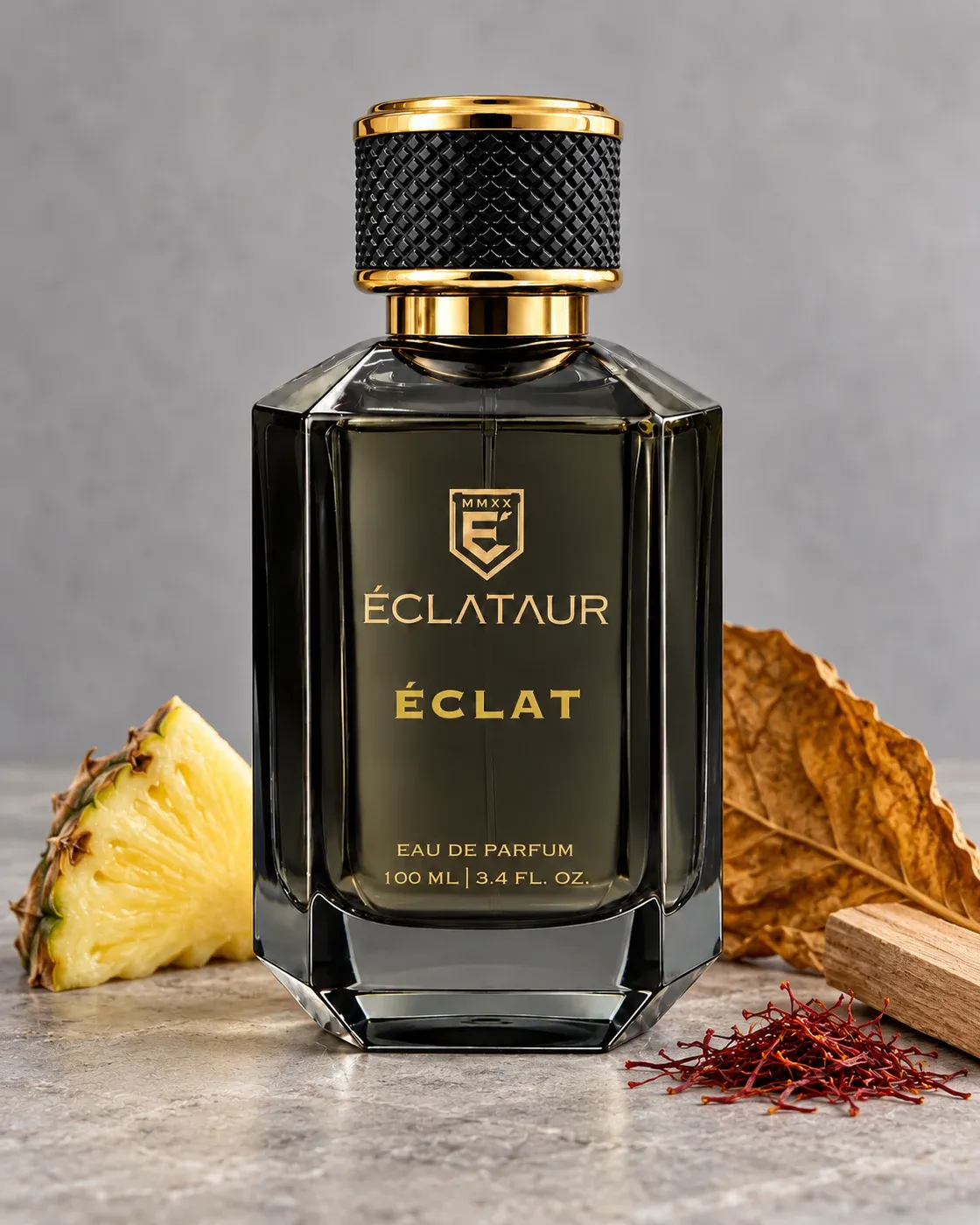
The brief protects the fragrance from the perfumer. A composition can always be improved by one more material, and the sentence written at the start is what decides when to stop. The house’s briefs say what a fragrance is not: ÉCLAT’s says smoke, not sweetness; SUNLATTE’s says cream, not cake. Reading a finished bottle against its brief is the first test it has to pass, before anyone smells it.
The materials are chosen with their papers. Every natural oil arrives with its supplier’s declaration of what it contains, and every molecule with its safety data; the trade’s standards set a ceiling on each material for a product worn on skin. The materials article explains why both kinds are used, and the label article explains what the declarations become on the box.
The bench is where the time goes. Trials are small, so that a wrong turn costs a few grams and a page rather than a batch. The perfumer smells each on paper for its shape and on skin for its truth, and leaves it a day, because a composition that is right at noon is often wrong by evening. The notes article reads one finished formula from top to base; this is where that order is decided.
The base is built once and used many times. VELUM is the house’s own base accord, set under every spray so that the handover from heart to dry-down is continuous rather than a drop. Because it is a structure and not a recipe, it produces an amber under CLARTE and a gourmand under SERAPH without either sounding like the other; the VELUM article explains the principle.
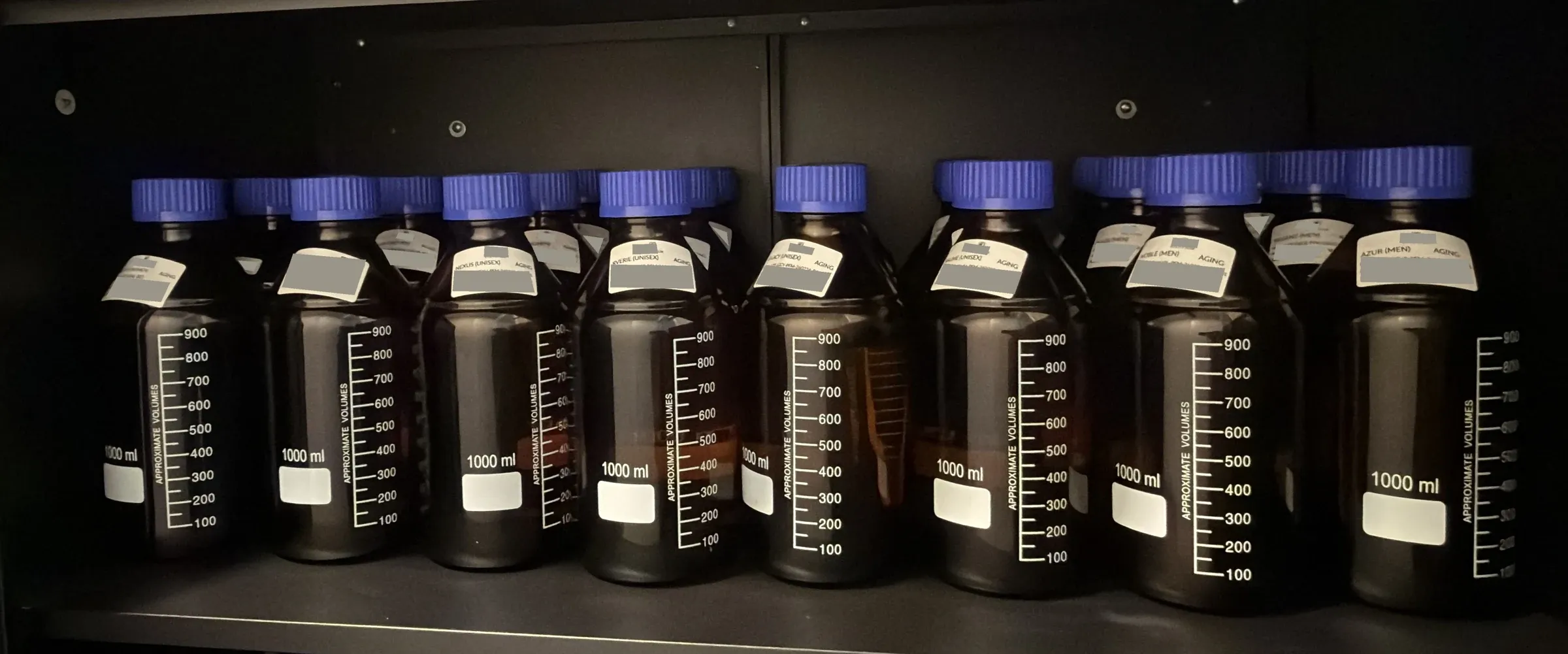
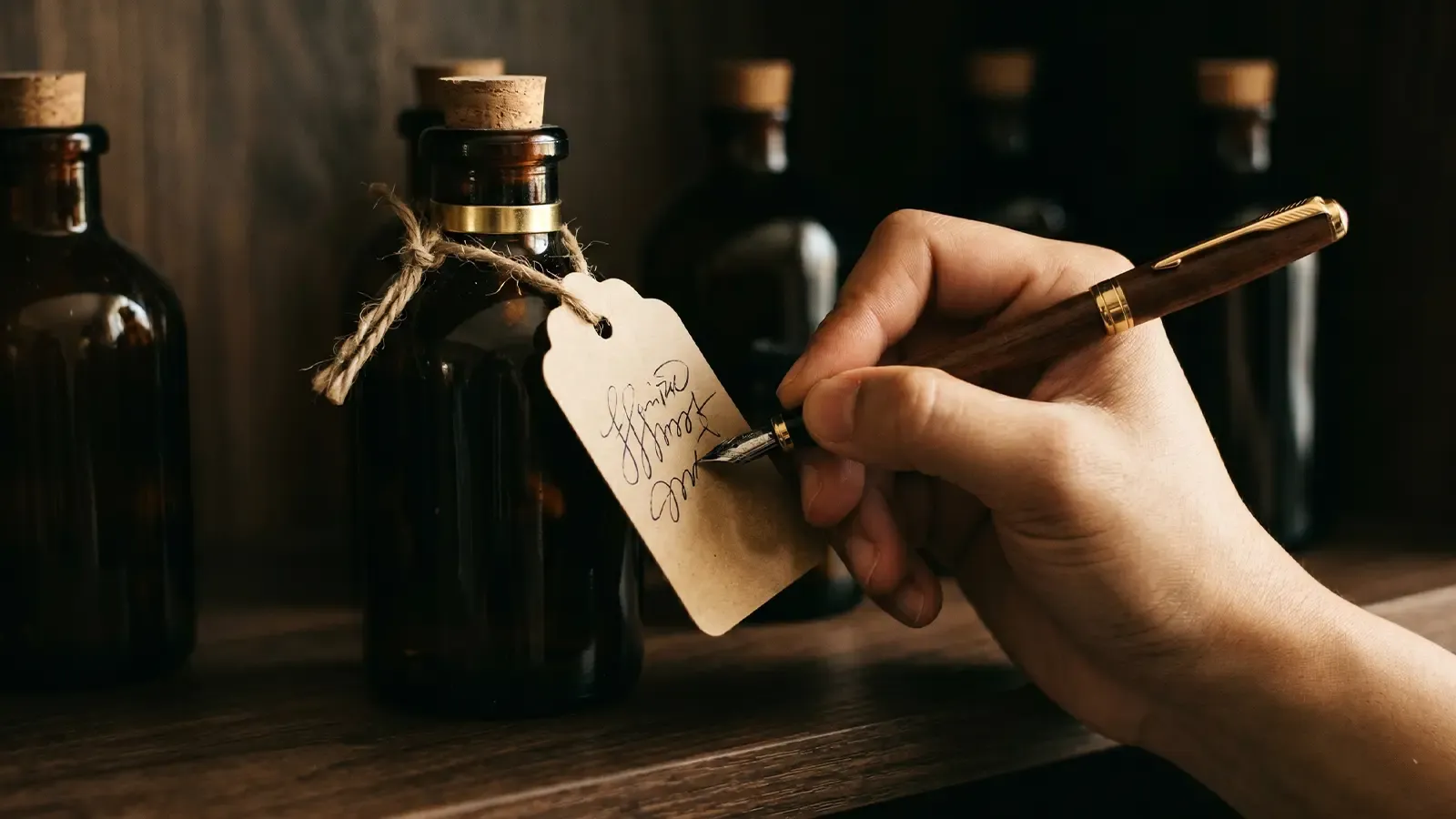
Inside the atelier’s cabinet: batches resting before evaluation. Private batch details on the labels have been concealed.
The rest is a decision, not a countdown. The maceration article describes it in full: what the perfumer looks for, what the cold filtration catches, and what resting cannot prove. The house publishes the practice and not a count of days, because the evaluation at the end is what decides, and a batch is not released because a date has arrived.
The bottle is the last place a fault can be caught. Hand filling is slow and that is its merit: every bottle is looked at, every atomiser tested, every label checked against the lot before the box closes. The tester vials for the Prelude are filled from the same batch at the same time, which is why what you test is exactly what you would own.
What a Small Atelier Does Differently
A large house does every one of these stages too, with a laboratory, a compounding floor and a filling line between them. What a small atelier changes is not the stages but who stands at each one. Here the person who wrote the brief weighs the trials, sets the base, smells the resting batch, and inspects the bottles. Nothing is handed across a counter to someone who did not smell the previous version. That is slower, and it is the reason the house makes in small batches and keeps every record itself: a fragrance that one person can trace from the first sentence to the sealed box is a fragrance that one person can answer for. It is also why the house can say what it does not do: no fragrance is bottled before it has been judged, no batch is released to meet a date, and no record is closed until the evaluation is written in it.
For a broader account of how perfume has been made across its history, Britannica’s entry on perfume is a sound starting point, and Fragrantica remains the most useful public record of how finished compositions are read by the people wearing them.
How Perfume Is Made: Your Questions Answered
How is perfume made, step by step?
In six stages: a brief that says what the fragrance is and is not; the choice of materials within the trade’s safety limits; the formula built in small weighed trials at the bench; the base accord and the carrier that turn the concentrate into a liquid; the rest in the dark, the cold filtration and the evaluation on skin; and the hand bottling, labelling and record. ÉCLATAUR walks every fragrance through all six in that order.
How long does it take to make a perfume?
The formula can take months of trials, and some take years; the batch then rests until it passes evaluation. The house does not publish a count of days for the rest, because the evaluation decides when a batch is finished, not the calendar. By the time a bottle is offered for sale, all of that time is behind it.
What is a perfume batch record?
The written account of one batch: the formula version, the materials and their lots, the date of blending, the inspections during the rest, the evaluation and its result, and the bottles filled. ÉCLATAUR keeps one for every batch and traces every bottle to it by the lot on its label.
Is perfume made by hand?
At the house, yes: the trials are weighed by hand, the batch is blended and rested by hand, and every bottle is filled, inspected and labelled by hand. A large house automates the compounding and filling; the stages are the same, the people at each one are not.
What does IFRA mean for how a perfume is made?
The International Fragrance Association publishes standards that set limits on how much of each material may be used in a product worn on skin. Those limits are checked when the palette is chosen, before a formula is written, so that nothing is composed that cannot be made. Every ÉCLATAUR fragrance is formulated in accordance with them.
Why are the testers filled from the same batch as the bottles?
So that what you test is exactly what you would own: the same formula, the same batch, the same rest and the same evaluation. The Prelude’s tester vials are filled at the same time as the bottles, which is the only honest way to let someone decide on their own skin before buying.